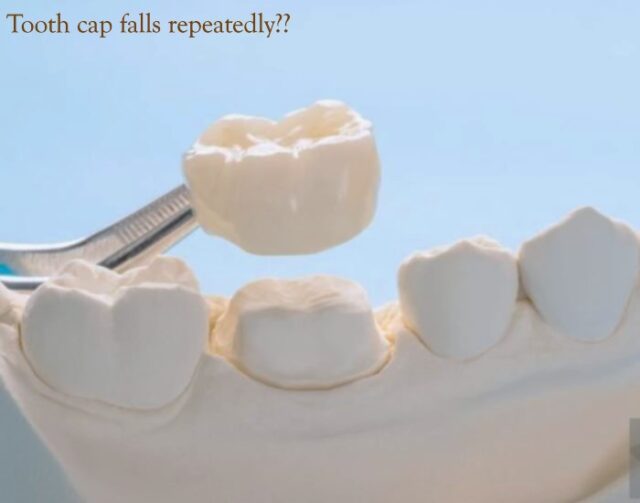
Why Does a Dental Cap Keep Falling Off?
Cemented vs Bonded Dental Crowns Explained
Many patients visit our dental clinic with a common complaint — their dental cap (crown) keeps coming off repeatedly. This can be frustrating, uncomfortable, and sometimes embarrassing for the patient.
In this article, we explain why dental caps get dislodged, the types of caps used in dentistry, and which type offers better long-term stability.
Types of Dental Caps (Crowns)
Dental caps placed over teeth are broadly classified into two main categories:
-
Cemented Caps (Crowns)
-
Bonded Caps (Crowns)
Understanding the difference between these two is crucial to know why some caps fall off repeatedly.
1. Cemented Dental Caps
Cemented caps are traditional dental crowns that are fixed using dental cement. In this method:
-
Cement is placed inside the cap
-
The cap is seated directly over the prepared tooth
-
No special surface treatment is done on the inner surface of the cap
Common Materials Used
-
Metal crowns
-
Porcelain (ceramic) crowns
-
Zirconia crowns
How Cemented Caps Stay in Place
Cemented caps rely only on mechanical retention, which depends on:
-
Available height of the tooth
-
Shape (taper) of the tooth preparation
-
Type of cement used
-
Any locking grooves created in the tooth
Why Cemented Caps Fall Off Frequently
-
Insufficient tooth height (very common)
-
Smooth tooth surfaces
-
High chewing forces
-
Sticky or hard foods
-
Aging or breakdown of cement over time
Even with good care and food restrictions, cemented caps have a higher chance of repeated dislodgement, especially when tooth height is inadequate. This often becomes a source of constant irritation for both patients and dentists.
2. Bonded Dental Caps
Bonded caps represent a more advanced and secure method of crown fixation.
How Bonded Caps Work
-
The cap is chemically bonded to the tooth structure
-
Special surface treatments are done on both the tooth and the inner surface of the cap
-
High-strength dental bonding agents are used
Key Advantage
Bonded caps attach so strongly that:
-
They are extremely difficult to remove
-
In many cases, removal requires breaking the cap
-
Sometimes even the tooth may fracture before the cap comes off
Common Example of Bonded Caps
-
Lithium Disilicate crowns
-
Commonly known as E.max caps or Li-DiSi crowns
-
These caps offer excellent retention, strength, and aesthetics, making them ideal in cases where traditional cemented caps fail repeatedly.
Cemented vs Bonded Caps: Which Is Better?
| Feature | Cemented Cap | Bonded Cap |
|---|---|---|
| Retention | Mechanical only | Chemical + mechanical |
| Chance of falling off | Higher | Very low |
| Suitable for short teeth | ❌ No | ✅ Yes |
| Long-term stability | Moderate | Excellent |
Final Takeaway
If your dental cap keeps falling off repeatedly, the problem is often not the cement, but the type of cap and method used. In cases of short or weak tooth structure, bonded crowns such as E.max caps provide a far more reliable and long-lasting solution.
Also,if you dont want to go for cemented cap where your tooth height is short,there is another way with which you can keep your in place without getting dislodged.Whats that?? Stay tuned for Part-2 of this article on https://microscopicdentist.com/blogs-and-news/
Meanwhile,if you are facing same situation and want a permanent solution from one of the best Dentist of India,Dr Jay Kothari you can visit his Clinic profile on https://share.google/YPknKfaXPKvC8LFFX
A proper clinical evaluation can help determine whether switching from a cemented crown to a bonded crown is the right solution for you or you need some alternate solution! Stay Tuned for part-2!